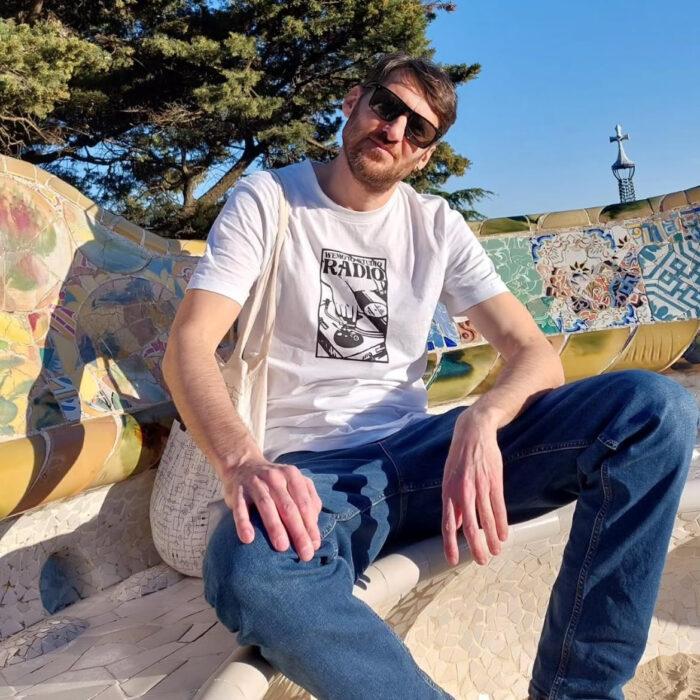
Born in Greenock, Grant Armor, Southend-on-Sea raised conductor and songwriter, now lives in South East London.
Grant has traveled the world for the past 10 years making documentaries on topics such as drugs, rave culture, climate activism, fetishes, mental health, prisons, ancient rituals, the homeless, LGBTQ + rights, and space tourism, to name a few.
He made the first documentary about Greta Thunberg and the Fridays for Future movement and has collaborated with Brian Eno on a film about the anniversary of the moon landing.
Grant has recently made documentaries on cartels distributing counterfeit drugs in Mexico, human rights abuses against indigenous peoples in Guatemala, and the drug death crisis in Scotland.
We have had the pleasure of speaking with him and this has been the result.
Can you tell us a little about your experience? Where are you from / how did you get into music? Was it all internet based?
I was born in Greenock just outside Glasgow. All my family are from there. It’s where they built the QE2 and Ken Loach shot Sweet Sixteen but I grew up in Southend-on-sea in Essex as my folks moved down south during the Thatcher years as there was hardly any work in Scotland at that time. My dad was involved in the New Wave scene in Glasgow so I was exposed to that music from an early age. Apart from growing up in the age of p2p music sharing, being a teenager in Southend introduced me to a lot of music as there was a scene centred around a night called Junk Club which bands like The Horrors and TNP came out of. So I guess those years were formative in opening me up to other forms of post punk, no wave, psych, proto-dance music and being in the South East you couldn’t escape the rite of passage that was jungle, dnb and uk garage. Since then I’ve always engaged in multiple genres online and IRL as most millennials do. Music in the future will be purely based on mood I think.
Who have been your main inspirations (both musical and in «life»)? And how have they affected your sound?
I’ve been working in film and mainly making documentaries for the past 10 years which has exposed me to a lot of stories, issues and complex emotions. Most of the influences for my music come from films rather than from other people’s music, for instance: the sound design of Italian giallos; the movement of the camera in Robert Altman’s Images; or even the editing style of Thelma Schoonmaker, if I had to narrow it down to musical influences it would be, Suzanne Vega, 2 Bad Mice, ESG, The Dust Brothers, and anything on Suburban Base Records.
How would you define your sound?
Moodcore
How has your sound evolved so far?
I’ve been mainly making music for films for the past decade, from ambient electronic scores to generic library music. I wanted to return to a more live instrument focused kind of music that would be listened to at home and sounds like the space I’m currently in. Music is all about space and currently I make music at home to be played in headphones or in your bedroom. I wanted to build a sound and song writing style from scratch so I started with a simple timbre, like beats, bass guitar, guitar and vocals. I’m beginning to introduce more keys, some synthesised sounds and have been experimenting further with more psychedelic production techniques.
What can you tell us about your last job? What inspired you? What do you want to convey?
I mainly make documentaries for a living. The last film I made was a documentary about the wrongful imprisonment of an Indigenous leader in Guatemala called Bernardo Caal Xol after he successfully filed a series of injunctions against the construction of a dam in the Rio Cahabon. I also scored the film. I wanted the to scroe to sound authentic so I asked his daughters to record each note on the marimba they play at home and I made an instrument out of it in Ableton. I used the sounds from it, processed electronically in one way or another throughout the score to convey the clash between ruthless, capitalist modernity and its exploitation of natural resources at the expense of Indigenous Peoples and their culture.
What can you tell us about each song that makes up your latest work? What is hidden behind?
My last release was a single called Wrap My Arms Around You. The song is about stepping outside of routine whether that be your job or even a hedonistic cycle to transcend into new realms right in front of your eyes. Whether that be falling in love, working on your relationships or immersing yourself in the everyday euphoria and the psychedelia of the natural world.
How are you living the current situation because of COVID? Has your work affected you a lot? Do you think there is hope? I feel like the underground scene will continue to persist.
I’m mainly stuck in my flat in South East London directing films remotely and making music. It suits me right now to be honest because I feel like I can actually focus on writing and recording music without much distraction. I think endlessly touring as a band or musician isn’t good for them physically, mentally or creatively. An artist needs to continue writing music rather than just playing the same songs over and over again. I do love playing live or DJing though and experiencing music surrounded by other people, so I have been playing and immersing myself in various nights in South East London, which has IMO the best underground electronic music in the world at the moment.
What projects are you working on right now?
I just directed and scored a documentary on Scotland’s cocaine epidemic which should be coming out early next year. I’m always writing new tracks and typically trying to finish them within 24 hours. I want to execute the initial idea and capture the emotion of the song quickly before it gets lost in the process.
SOCIAL MEDIA:
https://soundcloud.com/grantarmour
https://www.instagram.com/grantarmour/
https://twitter.com/avantgrant